
FAQ

Questions and Answers

What is fire prevention and firefighting?

Fire prevention and firefighting is a combination of measures and technical solutions aimed at eliminating or minimizing the risk of fire and explosion, while creating favorable and appropriate conditions for firefighting, rescue of people and property, effective fire suppression, prevention of fire spread, and minimizing damage caused by fires and explosions.

What equipment does a fire extinguishing system consist of?

Fire protection systems include: fire alarm systems, fire extinguishing systems, and fire pump systems. These systems are further divided into various fire alarm and extinguishing methods, utilizing different fire protection equipment from numerous manufacturers with varying price points.

What is fire-fighting foam?

“…Foam is a collection of air bubbles formed from foaming solutions, having a lower density than flammable liquids. It is primarily used to create a “blanket” over the surface of flammable liquids and prevent or extinguish fires by excluding oxygen (air) and cooling the fuel (cooling the combustion zone). Foam also prevents re-ignition by preventing the evaporation of fuel vapors. Foam has the property of adhering to surfaces, providing safe protection from adjacent fires.”

Why should you use fire-fighting foam?
Creates a “blanket” to cover the burning surface or area.
 
Is the only agent preventing fuel evaporation, thereby eliminating the possibility of re-ignition.
 
Rapid fire extinguishing capability.
 
Highly biodegradable, safe for humans and the environment.
 
Does not cause damage to furniture, property, and machinery during fire extinguishing.
The operating principle and usage of fire-fighting foam.
Foam fire suppression systems are widely used in high-risk fire and explosion areas, such as fuel storage tanks and hazardous chemical warehouses. Their superior characteristics reduce the amount of extinguishing agent needed to put out a fire, minimize damage to equipment and property, and reduce environmental pollution from the sprayed water, especially in areas containing hazardous substances.
 
Foam fire suppression systems operate primarily on the principle of isolation. When activated, the foam system sprays a foam that covers the surface of the fuel, separating the flammable liquid from the air and fire, thereby extinguishing the flames.
 
Due to their high effectiveness and the reduced water usage, foam systems are now widely trusted.
How should foam be stored?

Store in the manufacturer’s provided container in a cool, well-ventilated place. Avoid direct sunlight.

What is a fire extinguisher?

A fire extinguisher is a fire safety device used to extinguish or control small fires, usually in emergency situations. Typically, a fire extinguisher is a portable, cylindrical container with a pressure valve, containing a substance capable of extinguishing flames.

What types of fire extinguishers are there? What are the uses of each type?
+ CO2 Fire Extinguisher: CO2 fire extinguishers are specifically used to extinguish fires involving liquids (gasoline, oil, alcohol), gases (methane, natural gas), and electrical equipment.
 
+ Powder Fire Extinguisher: Depending on the type, each fire extinguisher can extinguish fires involving solids, liquids, gases, electrical fires, and newly ignited electrical equipment.
 
The fire extinguishing powder is non-toxic, non-conductive, and highly effective; the extinguisher is simple to use, easy to inspect, and suitable for extinguishing small, newly ignited fires.
 
+ Foam Fire Extinguisher: Foam forms a coating that burns oxygen and prevents re-ignition. Therefore, foam fire extinguishers are used on fires involving flammable liquids, such as gasoline, paraffin, paint, and oil. They should not be used on live electrical equipment or flammable metal fires.
The fire extinguishing principle of each type of fire extinguisher.
+ CO2 Fire Extinguisher: The fire extinguishing mechanism (effect) of a CO2 fire extinguisher is cooling, as liquid CO2 absorbs heat from the surroundings when it evaporates. It operates primarily with extremely high-pressure compressed gas containing inert nitrogen. Because it is a gas-based fire extinguisher, the CO2 extinguisher has a very wide fire extinguishing range, spreading very quickly, and is extremely effective at controlling Class A fires (wood, paper) and Class E fires (electrical). Ideal for use in factories with many electronic devices.
 
+ Powder Fire Extinguisher: Powder fire extinguishers contain N2 gas as a propellant to spray powder to extinguish fires.
 
+ Foam Fire Extinguisher: When sprayed, depending on its expansion rate, the foam will quickly cover the surface of the burning material and quickly extinguish the fire. In some cases, foam with high expansion capacity will quickly cover the flames, preventing them from absorbing oxygen and quickly weakening them until they are extinguished. Thanks to these properties, foam is not only used in fire extinguishers but also in fire suppression systems. Furthermore, foam with high expansion capabilities usually dissipates very quickly, thus not damaging goods, making it a popular choice for warehouses.
How should fire extinguishers be stored?
Place in an easily visible and accessible location for convenient firefighting.
 
Store in a dry, well-ventilated area, avoiding direct sunlight and strong heat radiation; the maximum temperature should not exceed 50°C. If stored outdoors, it must be covered.
 
Handle with care when moving. Avoid direct contact with high temperatures and vibrations.
 
Regularly inspect the cylinder according to the manufacturer’s regulations or at least every 3 months. If the indicator needle is below the red line, refill the gas.
 
Check the propellant gas using a pressure gauge or scale and compare it to the initial weight. Check the powder weight by weighing and comparing it.
 
Regularly inspect, maintain, and replace any damaged parts of the cylinder: nozzle, spray head, shut-off valve. Replace cylinders that are leaking gas.
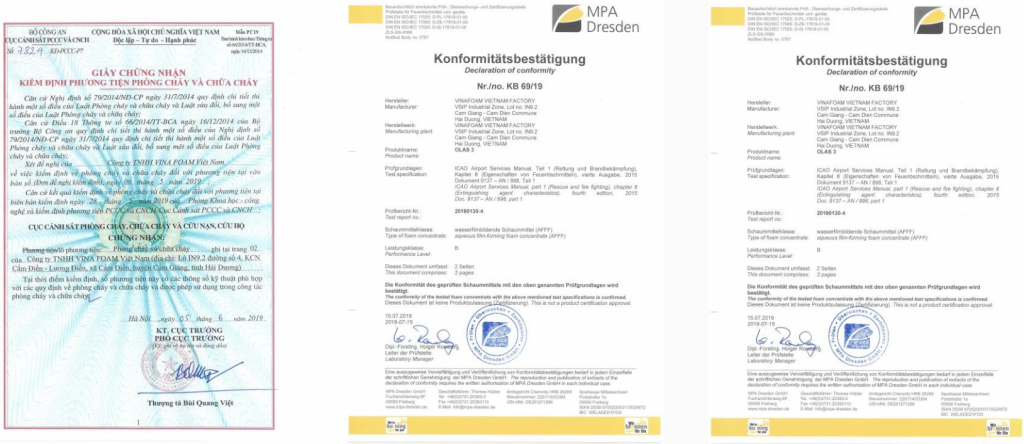
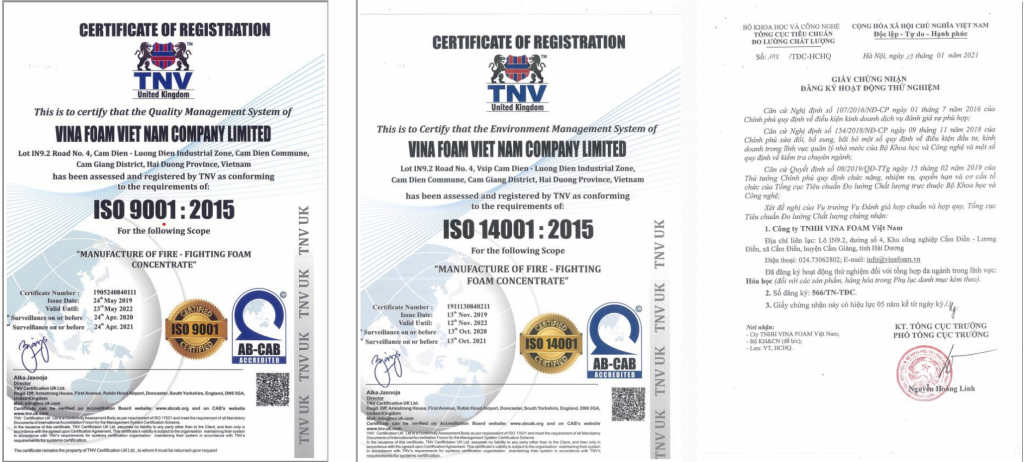
Do Vina Foam fire extinguishers and foam products come with inspection stamps?

All Vina Foam products undergo quality control throughout the production process and are tested before being released to the market.
What is the purchasing process?
1. For DOMESTIC (Vietnam) customers:
– Order hotline: 086 666 1114
– Fanpage: https://www.facebook.com/vinafoam.vn
– Purchase directly at the office: VINA FOAM Building, No. 1, Lane 6, Vu Duc Than Street, Viet Hung Ward, Long Bien District, Hanoi City
– Shopee: https://shopee.vn/vinafoamvietnam
 
2. For INTERNATIONAL (Export) customers:
– Hotline / WhatsApp: +84 8 6868 5609
– Email: phuong.dtb@vinafoam.vn
– Alibaba Store: https://i.alibaba.com/

CERTIFICATE